Income/Wages
Poorest Countries in Europe 2026

GDP per Capita IMF
0
$20K
$40K
$60K
$80K
$100K
$120K
$140K
$160K
Country | GDP per Capita IMF 2026↑ | |
|---|---|---|
 | Ukraine | $6,067 |
 | Austria | $6,368 |
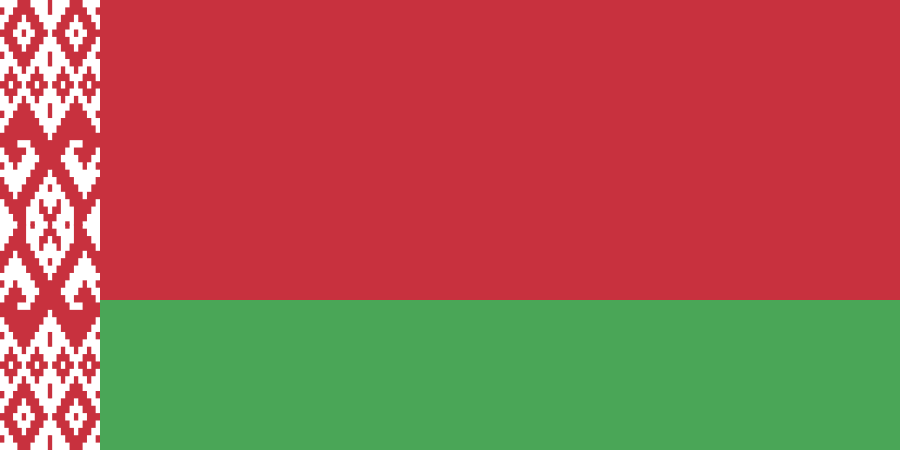 | Belarus | $8,878 |
 | Moldova | $9,105 |
 | Bosnia and Herzegovina | $9,167 |
 | North Macedonia | $10,184 |
 | Albania | $11,211 |
 | Serbia | $14,572 |
 | Montenegro | $14,873 |
 | Russia | $15,495 |
 | Bulgaria | $19,623 |
 | Romania | $23,066 |
 | Poland | $26,537 |
 | Croatia | $26,568 |
 | Greece | $26,688 |
 | Latvia | $27,203 |
 | Hungary | $27,351 |
 | Slovakia | $29,706 |
 | Lithuania | $32,218 |
 | Portugal | $32,354 |
 | Czechia | $34,712 |
 | Estonia | $34,931 |
 | Slovenia | $38,218 |
 | Spain | $38,707 |
 | Cyprus | $42,499 |
 | Italy | $43,020 |
 | Andorra | $46,819 |
 | Malta | $48,644 |
 | France | $51,113 |
 | United Kingdom | $56,144 |
 | Finland | $59,579 |
 | Belgium | $60,002 |
 | Germany | $60,136 |
 | Sweden | $61,700 |
 | San Marino | $63,528 |
 | Netherlands | $73,105 |
 | Denmark | $74,303 |
 | Norway | $90,233 |
 | Iceland | $94,821 |
 | Ireland | $110,906 |
 | Switzerland | $116,005 |
 | Luxembourg | $145,410 |
- GNI per capita is gross national income (GNI) divided by mid-year population. GNI is the gross domestic product (GDP) plus net primary income from abroad. GDP is the sum of the value of all goods and services rendered by a country’s residents.
- PPP GNI is gross national income converted to international dollars using purchasing power parity rates. An international dollar is a theoretical monetary unit that has the same purchasing power over GNI as a U.S. dollar in the United States.
Snapshot
-
Ukraine ranks as Europe’s lowest-income country, with per-capita income at $5,759, reflecting limited capital investment and weak labor-market earnings.
-
Several other European countries, including Moldova ($8,161) and Bosnia and Herzegovina ($8,668), also sit below $10,000 per person, due to smaller economies and lower productivity.
-
At the opposite end, countries such as Luxembourg and Switzerland exceed $100,000 per capita, revealing a stark contrast in income across European countries.
Income levels vary widely across Europe, with a small group of countries at the lower end where weaker earning power persists. Income per person provides a clearer view of everyday earning levels than total economic output, helping to tell national wealth from individual living standards. The lower-income countries are concentrated largely in Eastern and Southeastern Europe, where smaller economies, lower productivity, and limited capital investment dictate earning outcomes.
Poorest Countries in Europe by Income
The countries listed below represent the lowest end of Europe’s income distribution, based on income per person, as of 2025 data, which is the most up-to-date data available in early 2026.
*If counted as European countries rather than Asian countries, the transcontinental countries Armenia and Azerbaijan would also appear on the list.
1. Ukraine
Ukraine sits at the bottom of Europe’s income scale with a GDP per capita at $5,759, everyday earnings remaining low for much of the population. Years of disrupted industry and limited long-term investment have made it difficult for wages to rise in step with the rest of Europe.
2. Moldova
With a GDP per capita of $8,161, Moldova is one of Europe’s lowest-income countries, many households earning modest incomes by continental standards. A heavy reliance on agriculture and money sent home from abroad has limited higher-paying opportunities within the country itself.
3. Belarus
Belarus ($8,460) remains near the lower end of Europe’s income rankings despite having a sizable industrial base. An economy dominated by state-run enterprises has left little room for faster productivity gains or stronger wage growth.
4. Bosnia and Herzegovina
Bosnia and Herzegovina ($8,668) also ranks among Europe’s lowest-income economies, where average pay remains subdued. A complex political and administrative structure has slowed investment and made it harder to create stable, well-paying jobs.
5. North Macedonia
In North Macedonia ($9,439), many workers earn relatively modest wages. Limited export industries and persistent unemployment have kept upward pressure on incomes muted.
6. Albania
Albania remains a lower-income European country at a GDP per person of $10,386, even as its economy has steadily expanded. Widespread informal work and uneven productivity across sectors continue to hold down average earnings.
7. Serbia
With a GDP per capita of $13,490, Serbia falls within Europe’s lower-income group, though it has made more progress than some neighboring countries. Much of its economy centers on mid-level manufacturing and energy, which has limited faster wage growth.
8. Montenegro
Montenegro sits in Europe’s lower-income tier with a GDP per capita of $13,961, shaped by the realities of a small national economy. Heavy dependence on tourism means incomes often rise and fall with seasons and external demand.
9. Russia
With a GDP per capita of $15,077, Russia appears among Europe’s lower-income countries despite its massive overall economy. Income levels are weighed down by large regional gaps and industries that generate wealth without employing large portions of the workforce.
10. Bulgaria
Bulgaria ($18,456) remains one of the European Union’s lowest-income members, with wages trailing much of the bloc. Slower productivity growth has made income convergence with Western Europe a gradual process.
Income Poverty in Europe: How to Read the Data
When people talk about the “poorest” countries in Europe, they are often mixing different ideas together. Income per person reflects average earning power, but it does not always translate directly into day-to-day hardship. A country can have relatively low incomes while still providing access to healthcare, housing support, and basic services that soften the impact on everyday life.
Low income in Europe also tends to cluster by region rather than appearing randomly across the continent. Eastern and Southeastern Europe account for most of the countries at the lower end of the income scale – those shaped by smaller economies, narrower industry bases, and slower productivity growth. These patterns are structural and persistent, not simply the result of short-term economic cycles.
Comparisons beyond Europe can also be misleading. Poverty is measured differently across countries, and income levels alone do not account for cost of living or social safety nets. As a result, lower income in Europe does not necessarily imply the same lived experience of poverty seen elsewhere, which shows the importance of understanding what the data really illustrates.